Repipe vs Repair in Manufactured Home Plumbing
Own a manufactured or mobile home with gray PB or older PEX piping? Learn when a full repipe makes sense, when spot repairs are enough, and what to expect in tight crawl spaces.
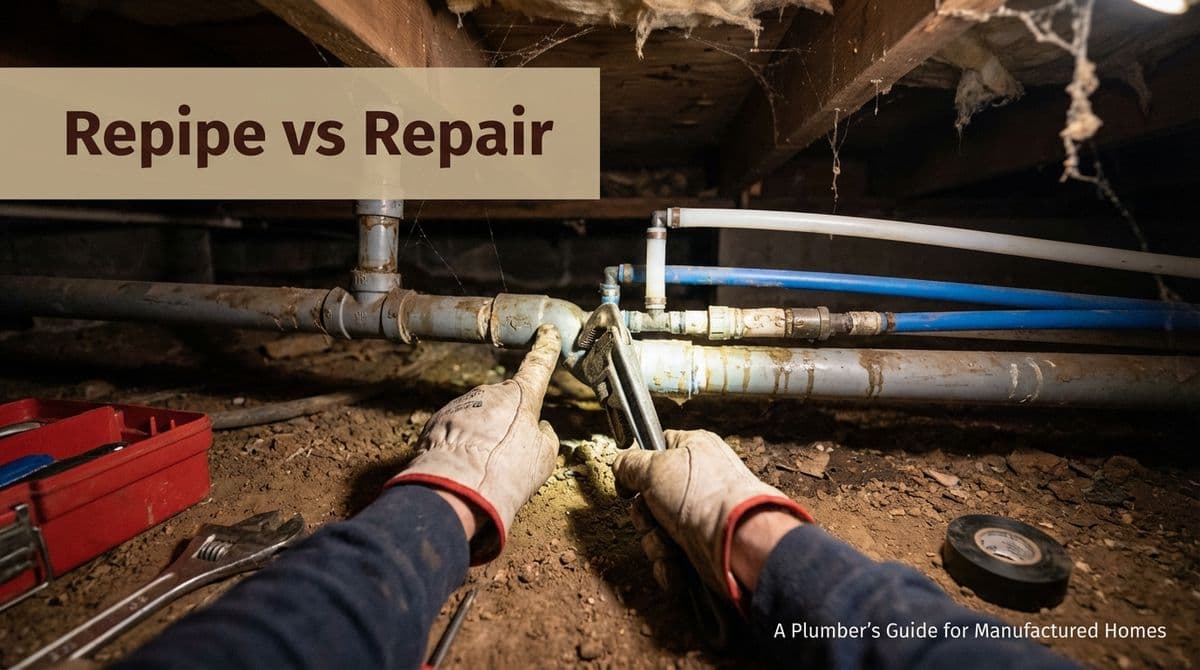
Repipe or Just Repair? A Real Call From a Mobile Home Owner
We recently got a call from a new homeowner in a manufactured home park here in town—let's call her Mary. She and her husband had just bought an older home in a park with a tight crawl space. They’d called another company out for a water heater estimate, and that tech came back with three separate quotes: one for a new water heater, one for water heater plus duct work, and one for water heater, ducts, and a complete repipe of the water system underneath the home.
By the time Mary called us, they were worried. The previous company had found old leaks, patched spots, and plastic piping under the home and suggested that everything should be replaced “just to be safe.” Mary’s big question was simple: “Do we really need to repipe the whole thing, or can we just repair what’s leaking?”
That’s a question we hear a lot in manufactured and mobile homes—especially those with polybutylene or older PEX piping in a crawl space. As a company, we try hard to give honest guidance, not just sell the biggest job.
What’s Actually Under Most Manufactured and Mobile Homes?
When we talk with homeowners in manufactured or mobile homes, the first thing we explain is that these homes usually don’t use the same plumbing materials as site-built houses. Instead of long straight copper or rigid PEX runs, manufacturers often install coiled plastic piping:
- PEX (cross-linked polyethylene) – Usually red, blue, or white; common in newer homes.
- Polybutylene (PB) – Often gray; used heavily in older manufactured homes and the source of many past lawsuits.
PB piping, in particular, has a history of issues: fittings failing, lines bursting, and small leaks that show up over time. That’s why some companies automatically recommend a full repipe as soon as they see gray pipe.
Our view is more balanced: we inspect, we document, and then we talk through the actual condition of what you have—not just what the material’s reputation is.
How We Decide: Repipe vs. Spot Repair
When we crawl under a manufactured home like Mary’s, we look for a few key things before recommending repair or repipe:
- Number and age of past repairs – A couple of well-done repairs is one thing; dozens of makeshift patches with mixed fittings is another.
- Type of piping – Gray polybutylene gets more scrutiny; newer PEX in good shape may have plenty of life left.
- Water pressure and signs of stress – High pressure, kinks, UV damage, or rubbing against sharp edges can shorten lifespan.
- Crawl space conditions – Standing water, rodents, or sagging supports all increase risk of future leaks.
Our general approach, especially with older polybutylene or PEX, is conservative on cost and disruption: fix what’s broken, then monitor. We’ll tell you if a full repipe is strongly recommended, but we don’t assume it’s the only option.
When a Full Repipe Makes Sense
We usually lean toward a full repipe in a mobile or manufactured home when:
- You’ve had multiple leaks in different areas within a short time.
- The crawl space shows extensive DIY or mismatched repairs that are likely to fail.
- The piping is gray PB that’s visibly brittle, cracked, or heavily patched.
- You’re planning to stay in the home long-term and want to minimize future surprises.
In those cases, the cost of repeated emergency calls and water damage can easily outweigh the one-time cost of a repipe.
When Spot Repairs Are Usually Enough
On the other hand, we often recommend targeted repairs instead of a full repipe when:
- The leak is isolated and the rest of the lines look solid.
- There are only one or two previous, professional-quality repairs.
- The piping is older but not cracked, chalky, or heavily UV-damaged.
- Your budget is tight and you’re okay fixing problems as they appear.
We’ll be up-front: “Yes, we can rip everything out and start fresh—but this system may still last another 10–20 years with only occasional repairs.” Then we let you decide based on your comfort level and risk tolerance.
Special Challenges: Tight Crawl Spaces Under Mobile Homes
Just like in Mary’s case, many manufactured homes have very low, tight crawl spaces. That affects both what we can do and what it costs. A few things to expect:
- Access matters – A 5'8" tech in a slim coverall can sometimes reach areas a bigger tech simply can’t. As a team, we send whoever is safest and best suited for the space.
- Work takes longer – Crawling and sliding instead of walking, working on your side, and maneuvering tools in a low space all add time.
- Safety first – We check for electrical hazards, sharp metal, loose ductwork, rodents, or standing water before anyone goes under.
When we schedule your job, we’ll talk honestly about crawl space limitations and how they may affect the scope, price, and timeline.
How Long Does a Repipe or Repair Usually Take?
Every home is different, but here’s a rough guide for manufactured and mobile homes:
- Single leak repair in a crawl space: often 1–3 hours, depending on access and how far the leak is from the access hatch.
- Multiple repair points found at the same time: half a day to a full day.
- Full under-floor repipe on a typical single-wide: usually 1–2 days.
- Full under-floor repipe on a double-wide with tricky access: 2–3 days.
We do our best to keep your water on as much as possible. For repipes, there will usually be a period—often a few hours—when we shut water off to tie in new lines. We’ll explain that schedule before we start so you can plan around it.
Simple Ways to Extend the Life of Existing Piping
If we come out and you decide to stick with repairs instead of a full repipe, there are a few things you can do to protect what you already have:
- Add a pressure-reducing valve (PRV) if your water pressure is high; that takes stress off older PB and PEX lines.
- Fix small leaks quickly rather than waiting—moisture in a crawl space can damage supports, ducts, and insulation.
- Insulate exposed sections of pipe near skirting or access doors to reduce freeze risk.
- Schedule a quick crawl-space check every few years so we can catch problems before they turn into floods.
These small steps are much cheaper than repeated emergency calls—or repairing flooring and cabinets after a big leak.
How We Help You Decide What’s Right for Your Home
With Mary, our plan was straightforward: get on site, look at the water heater, inspect the lines under the home, and then give separate estimates—one for the heater, one for repairs or repipe. That’s how we like to operate as a company: clear options, honest pros and cons, and no pressure to choose the biggest project.
If you’re in a manufactured or mobile home with gray polybutylene or older PEX and you’re wondering whether to repipe or just repair, we’re happy to crawl under, take photos, and talk you through what we see. In the end, the decision is yours—but our job is to make sure you have the information you need to feel confident about it.